Cellular Coenzyme (High Concentration)
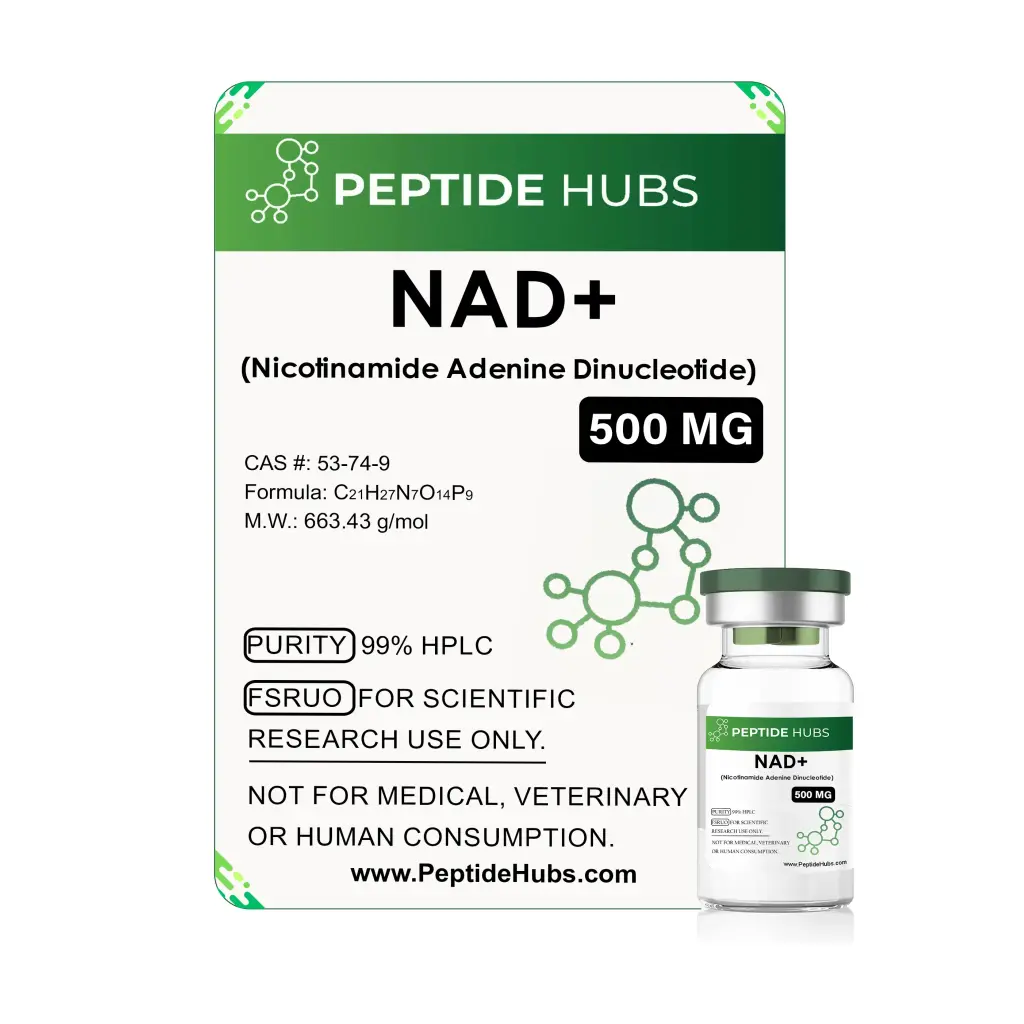
Active Substance: Nicotinamide Adenine Dinucleotide
Manufacturer: Peptide Hubs
Unit: 2 mL Vial (500 mg/vial)
Form: Lyophilized Powder
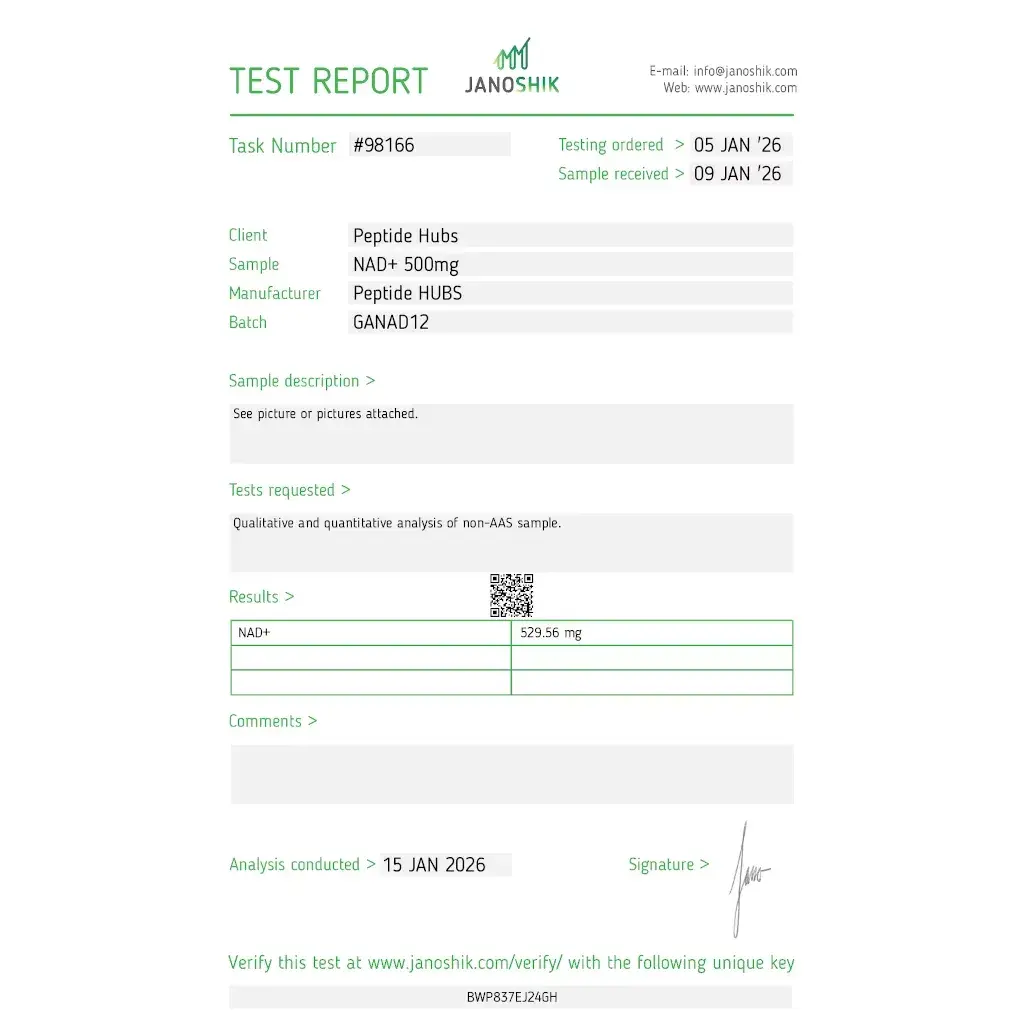
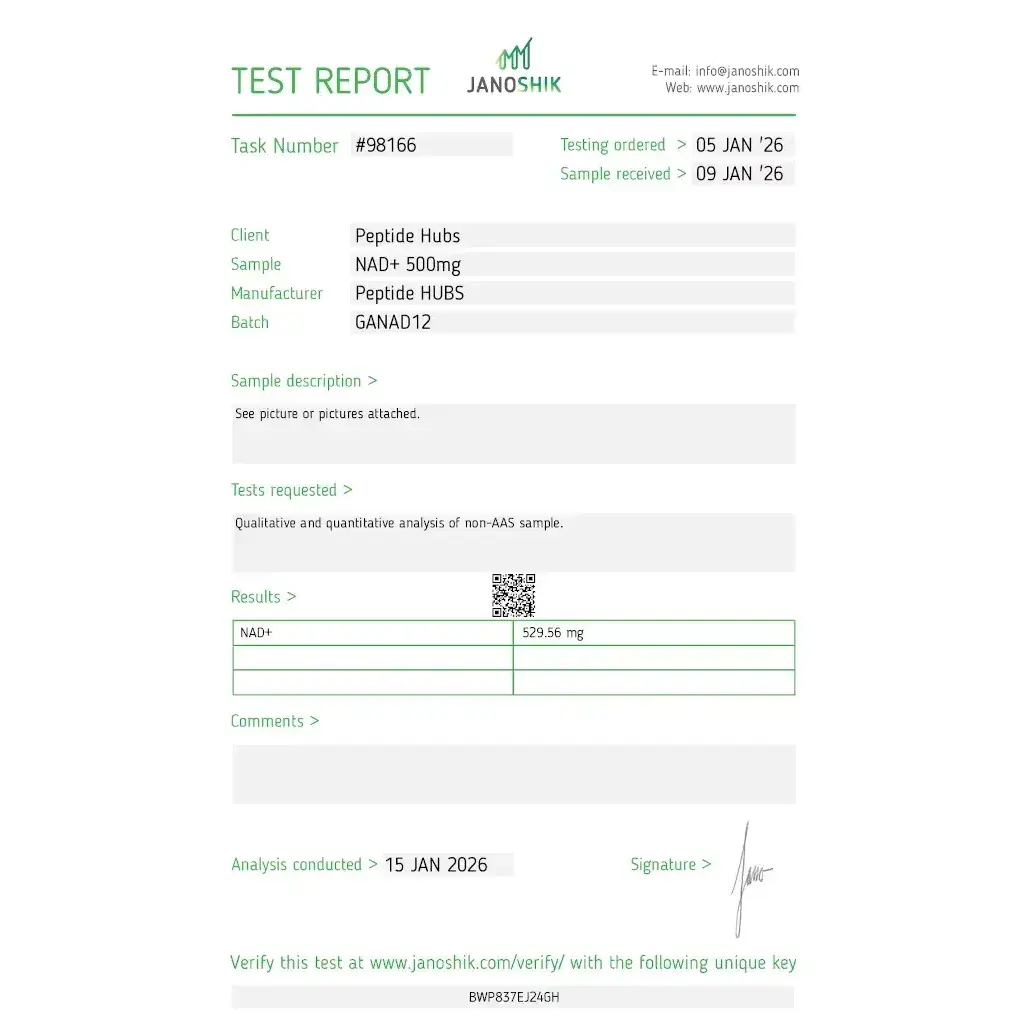
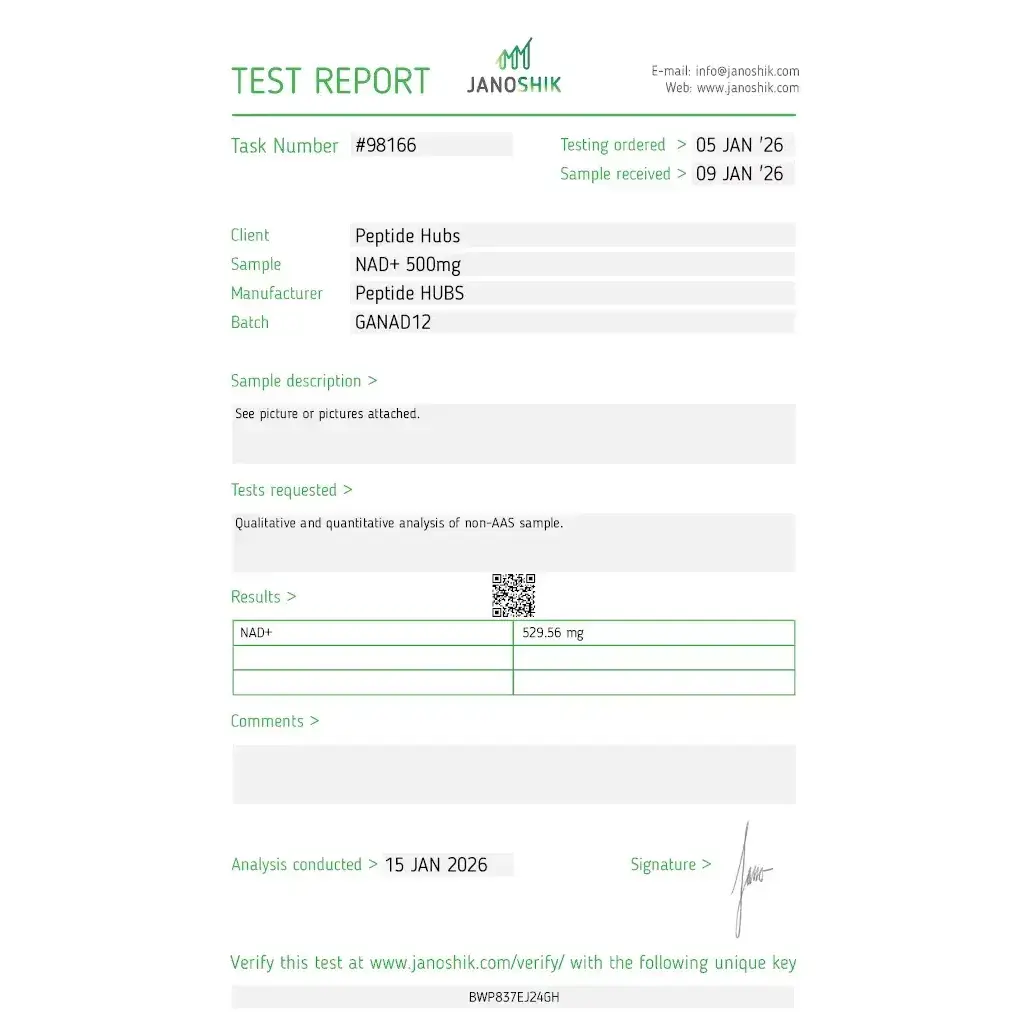
Laboratory Tested: View Lab Result
USA Domestic: 2-7 Days Delivery
International: 5-20 Days Delivery
NAD+ 500 mg represents a high-concentration formulation of nicotinamide adenine dinucleotide, presented as 500 mg of lyophilized powder in a sterile 2 mL vial. This high-potency coenzyme formulation enables advanced research into cellular energy metabolism, aging mechanisms, and mitochondrial function at concentrations previously challenging to achieve in experimental settings. Independently verified at 529.56 mg content (105.9% purity), this pharmaceutical-grade NAD+ provides researchers with unprecedented dosing flexibility for investigations requiring substantial coenzyme delivery. Manufactured under exacting quality control standards, the 500 mg concentration addresses the growing research demand for higher NAD+ doses in studies exploring cellular resilience, metabolic regulation, and age-related decline reversal.
Each vial contains 500 mg of high-purity β-Nicotinamide Adenine Dinucleotide (oxidized form) with enhanced stability characteristics:
The high-concentration formulation maintains NAD+'s structural integrity while enabling research applications requiring substantial coenzyme delivery unavailable in standard 100 mg preparations.
The 500 mg concentration enables advanced research previously limited by dosage constraints:
While this product is for research use only, scientific literature provides context for high-dose NAD+ applications. According to research published in Science, restoring NAD+ levels in aged mice improved mitochondrial function, enhanced muscle strength, and extended healthspan. The study utilized doses equivalent to approximately 400-500 mg/kg in mouse models, highlighting the need for higher concentrations in aging intervention research. Further investigation in Cell Metabolism demonstrated that NAD+ precursors at high doses could improve cognitive function and reduce neuroinflammation in Alzheimer's disease models. These studies underscore the importance of higher NAD+ concentrations for investigating age-related decline and metabolic disorders in research settings.
Important: The following information is derived from published research and should only guide experimental design in appropriate research models. Always consult institutional protocols.
High-dose NAD+ administration presents unique pharmacokinetic considerations:
Researchers should monitor for effects specific to high-concentration administration:
This high-concentration formulation requires additional safety considerations:
Administration significantly above established high-dose parameters may produce amplified effects including pronounced metabolic disturbances, potential electrolyte imbalances, or excessive redox state alterations that could compromise animal welfare. Researchers should implement comprehensive monitoring including metabolic panels, behavioral assessments, and physiological measurements. Emergency procedures should include capabilities for metabolic support, fluid administration, and intensive monitoring for research models receiving very high NAD+ doses.
The 500 mg concentration enables research combinations requiring substantial NAD+ co-administration:
These high-dose combinations should only be investigated by experienced researchers with appropriate infrastructure for comprehensive physiological monitoring and ethical oversight. Studies should include careful dose justification, escalation protocols, and contingency planning for potential amplified effects.
Each high-concentration unit features specialized packaging:
The 500 mg concentration necessitates enhanced storage protocols:
The development of a stable 500 mg NAD+ formulation represents a significant advancement for aging, metabolism, and mitochondrial research. As detailed in expanding scientific literature, effective NAD+ restoration in age-related decline and metabolic disorders often requires doses exceeding those achievable with standard preparations. The January 15, 2026 laboratory verification showing 529.56 mg content (105.9% purity) in the 500 mg vial demonstrates exceptional manufacturing precision for this challenging high-concentration formulation. This advancement enables researchers to explore dose ranges relevant to translational applications, investigate saturation kinetics of NAD+-dependent pathways, and conduct long-term intervention studies without frequent reconstitution. The preserved oxidized redox state ensures compatibility with research on sirtuin activation, PARP-mediated DNA repair, and cellular signaling—processes specifically dependent on NAD+ rather than its reduced form. By providing this high-concentration option alongside standard 100 mg preparations, Peptide Hubs supports comprehensive research spanning from mechanistic studies to intervention protocols with potential translational relevance.
The independent laboratory analysis conducted on January 15, 2026, confirms the high-concentration NAD+ vial contains 529.56 mg of active content against the labeled 500 mg, representing a 105.9% purity rating that demonstrates exceptional manufacturing precision for this challenging formulation. This verification ensures researchers receive accurately dosed high-concentration materials for advanced investigations into cellular energy metabolism, aging interventions, and metabolic regulation requiring substantial NAD+ delivery.
The 500 mg concentration enables several advanced research applications: 1) High-dose metabolic studies in large animal models where standard concentrations would require excessive injection volumes; 2) Chronic aging intervention research requiring sustained NAD+ elevation over weeks or months; 3) Dose-response investigations exploring the full therapeutic range of NAD+ effects; 4) Combination therapy studies maintaining appropriate molar ratios with other compounds; 5) Pharmacokinetic research requiring measurable tissue concentrations; 6) Rescue studies in severe metabolic dysfunction models where higher doses may be necessary. This concentration addresses limitations of standard 100 mg preparations for translationally relevant research.
Reconstituting 500 mg NAD+ requires special considerations: Use 2 mL of sterile phosphate-buffered saline (pH 7.4) to achieve 250 mg/mL concentration—this creates a highly concentrated solution that may require gentle warming to 37°C in a water bath and extended mixing (5-10 minutes of gentle swirling) for complete dissolution. Avoid vigorous shaking. The solution will be viscous; ensure complete dissolution before administration. For administration in species sensitive to high osmolarity or small injection volumes, consider reconstituting with larger volumes (3-4 mL) while maintaining sterility. Always verify complete dissolution visually and by lack of particulate matter before use.
500 mg NAD+ requires enhanced storage: Store at -20°C to -80°C (-4°F to -112°F), with -20°C minimum for active use. Transport on dry ice. Absolute light protection is essential—use amber vials and work under yellow/red light when possible. Once reconstituted, use immediately; do not store reconstituted solution. If absolutely necessary, store at 2-8°C for no more than 2 hours. Monitor for color changes (yellowing indicates degradation) more frequently than with standard concentrations. Avoid freeze-thaw cycles. Properly stored lyophilized powder maintains stability for 12 months. Implement continuous temperature monitoring during storage.
Yes, high-concentration administration requires additional safety considerations: 1) Implement dose escalation protocols rather than immediate high-dose administration; 2) Use proper injection technique to minimize local tissue irritation from concentrated solutions; 3) Enhance metabolic monitoring, particularly for glucose homeostasis and liver function; 4) Consider dividing doses or using slower infusion rates in sensitive models; 5) Monitor for injection site reactions more closely; 6) Develop specific protocols for this concentration rather than adapting standard protocols; 7) Maintain detailed records specific to high-dose use; 8) Have contingency plans for potential amplified effects. Always work within established research guidelines and institutional approvals.
Choose 500 mg NAD+ for: 1) Studies requiring doses above 100 mg/kg in standard rodent models; 2) Research in larger species where injection volume limitations favor higher concentrations; 3) Long-term chronic administration protocols minimizing reconstitution frequency; 4) Dose-response studies spanning wide concentration ranges; 5) Investigations where maintaining specific NAD+:compound ratios is essential; 6) Pharmacokinetic studies requiring measurable tissue levels. Choose 100 mg NAD+ for: 1) Standard dose studies in small animal models; 2) Initial dose-finding investigations; 3) Cell culture research; 4) Studies where smaller, more frequent reconstitution is preferable; 5) Research with established protocols using standard concentrations. Many research programs utilize both concentrations for comprehensive investigation.
Please log in to write NAD+ 500 mg review.
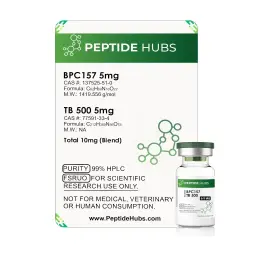
Synergistic Healing Peptide Blend
Active Substances:
- TB-500 (5 mg)
- BPC-157 (5 mg)
Brand: Peptide Hubs
Unit: 2 mL Vial (10 mg total/vial)
Form: Lyophilized Powder
Laboratory Tested: View Lab Result
USA Domestic: 2-7 Days Delivery
International: 5-20 Days Delivery
Nootropic/Anxiolytic Peptide
Active Substance: Semax
Brand: Peptide Hubs
Unit: 2 mL Vial (10 mg/vial)
Form: Lyophilized Powder
Laboratory Tested: View Lab Result
USA Domestic: 2-7 Days Delivery
International: 5-20 Days Delivery
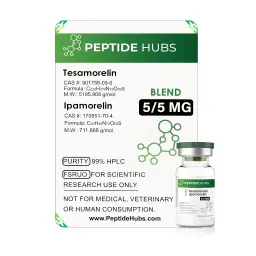
Synergistic GHRH & GHRP Peptide Blend
Active Substances:
- Tesamorelin (5 mg)
- Ipamorelin (5 mg)
Brand: Peptide Hubs
Unit: 2 mL Vial (10 mg total/vial)
Form: Lyophilized Powder
Laboratory Tested: View Lab Result
USA Domestic: 2-7 Days Delivery
International: 5-20 Days Delivery
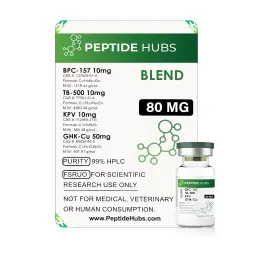
Research Peptide Blend
Active Substances:
- Ac-KPV-NH2 10 mg
- BPC 157 10 mg
- TB 500 10 mg
- GHK-Cu 50 mg
Manufacturer: Peptide Hubs
Unit: 2 mL Vial (80 mg/vial)
Form: Lyophilized Powder
Laboratory Tested: View Lab Result
USA Domestic: 2-7 Days Delivery
International: 5-20 Days Delivery
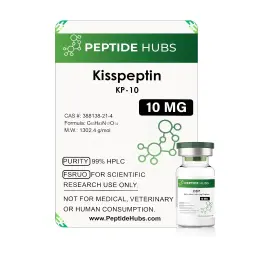
Neuropeptide (GnRH Secretagogue)
Active Substance: Kisspeptin-10
Manufacturer: Peptide Hubs
Unit: 2 mL Vial (10 mg/vial)
Form: Lyophilized Powder
USA Domestic: 2-7 Days Delivery
International: 5-20 Days Delivery
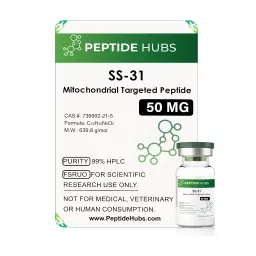
Mitochondrial-Targeted Tetrapeptide
Active Substance: SS-31 (Elamipretide)
Brand: Peptide Hubs
Unit: 2 mL Vial (50 mg/vial)
Form: Lyophilized Powder
USA Domestic: 2-7 Days Delivery
International: 5-20 Days Delivery